Osteria Francescana: twice number one in the world, a pasta for a lifetime
By Thiago Freitas · The Prime Traveler
Michelin: edition indicated above. World’s 50 Best: best historical ranking, with the year it was achieved.
In July 2026, we went to Modena to experience Massimo Bottura’s modern Italian cuisine. Amid art, memory and provocations, a tagliatelle became the best pasta I have ever eaten.
If I had to pick a single memory of Osteria Francescana, it would be the pasta. In the middle of a menu full of ideas and artistic references, a dish arrived that made me think something very simple: this is the best pasta I have ever eaten in my life.
It was in July 2026, in Modena, Italy. We were at yet another house that had once held first place at The World’s 50 Best Restaurants. Expectations were high, but the experience had a very distinct identity: Massimo Bottura’s modern Italian cuisine, built on ingredients, traditions and a constant desire to reinterpret them.
A great table, on an intimate scale
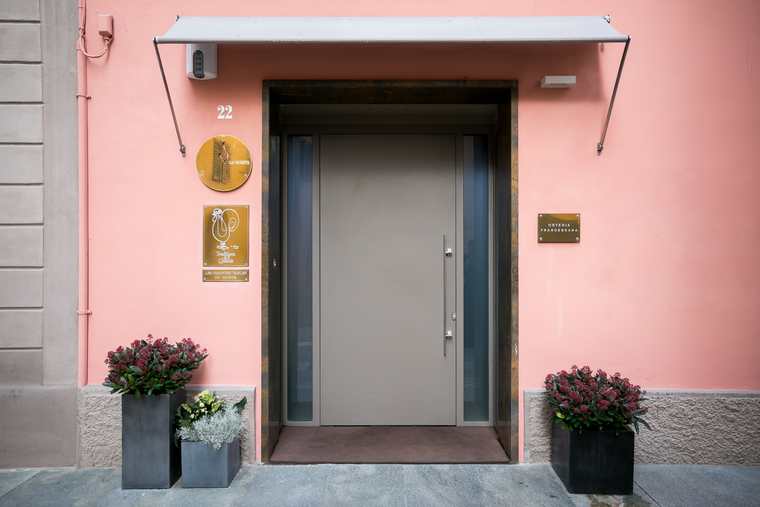
Osteria Francescana is at Via Stella 22, in the historic center of Modena. It is an address you seek out for the cooking and the history built there. Bottura’s restaurant was voted the best in the world in 2016 and again in 2018; it is now part of the Best of the Best, a category that gathers former winners and removes them from the annual competition. [1] [2] [15]
In the 2026 edition of the Michelin Guide, the house kept its three stars. These honors help place the importance of the restaurant, but the feeling of walking in was far more intimate than such titles might suggest. [3]
In the room where we sat, I remember about five tables. The low ceiling and subdued lighting gave the space a private atmosphere. The pale tablecloths and the light over the plates focused attention on what was happening at the table. Service was attentive and polite, accompanying the meal with discretion.
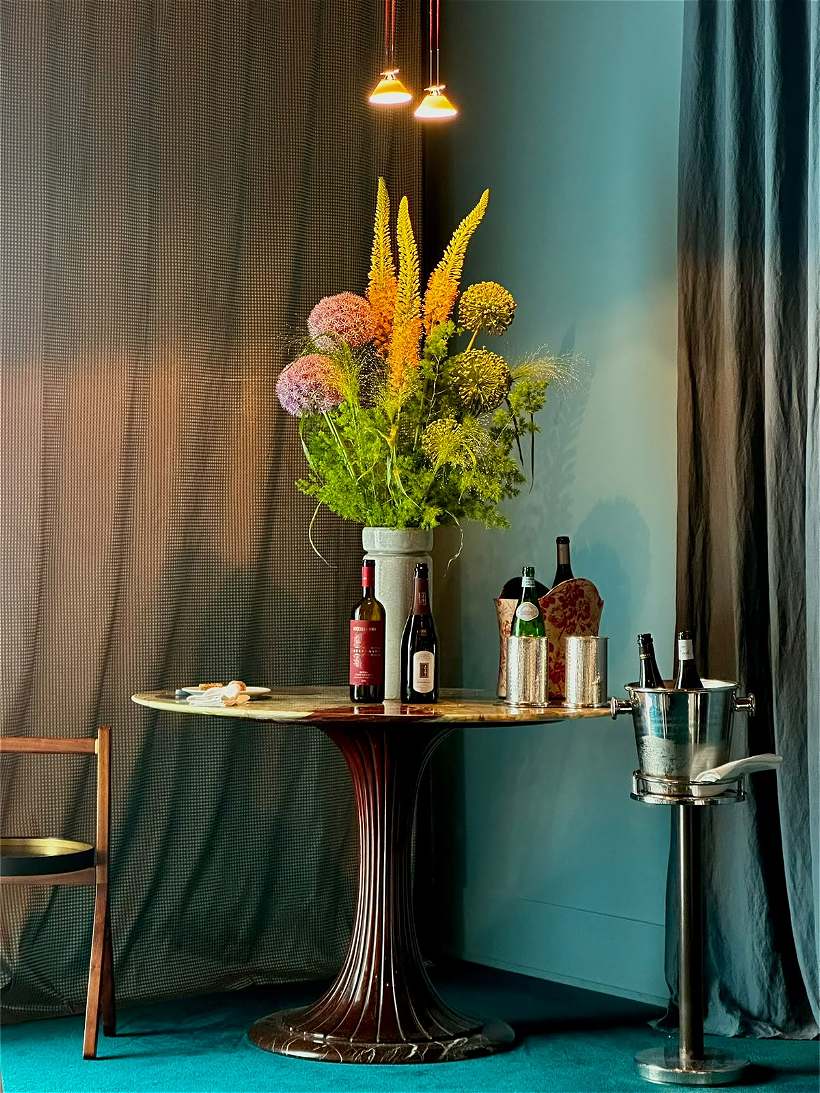
There is something special about this scale. We can observe each preparation, hear its presentation and let the meal take the time it needs. The luxury of this experience also lies in being able to give attention to a kitchen that has a lot to say.
Ho Fame! Ho Fame!: art as a starting point
The menu we received was called Ho Fame! Ho Fame!, something like “I’m hungry! I’m hungry!”. The concept is inspired by a ceramic work by Vincenzo Cabiati. At Francescana, hunger is also curiosity: the desire to know, to question and to turn references into food. [4]
The menu from our visit helps reconstruct the journey. Among the names were Artusi, Difesa della Natura, Achrome and Grande Rosso; then came the reinterpretation of pasta e fagioli, Tagliatelle 3.0 and Mediterraneo Contemporaneo. Alba, La Luce, L’Oscurità and Untitled led the way to the close.
It was a sequence in which each title opened a possible reading. Some dishes had an immediate visual relationship with art. Others showed how a familiar Italian recipe could receive a new interpretation and remain deeply tied to its origin.
Artusi and the first bites
The opening brought together small preparations on a rectangular plate, accompanied by a cup. The name Artusi refers to Pellegrino Artusi and his place in the history of Italian cooking. It is a beginning that stages tradition through bites of different shapes and colors. [5]
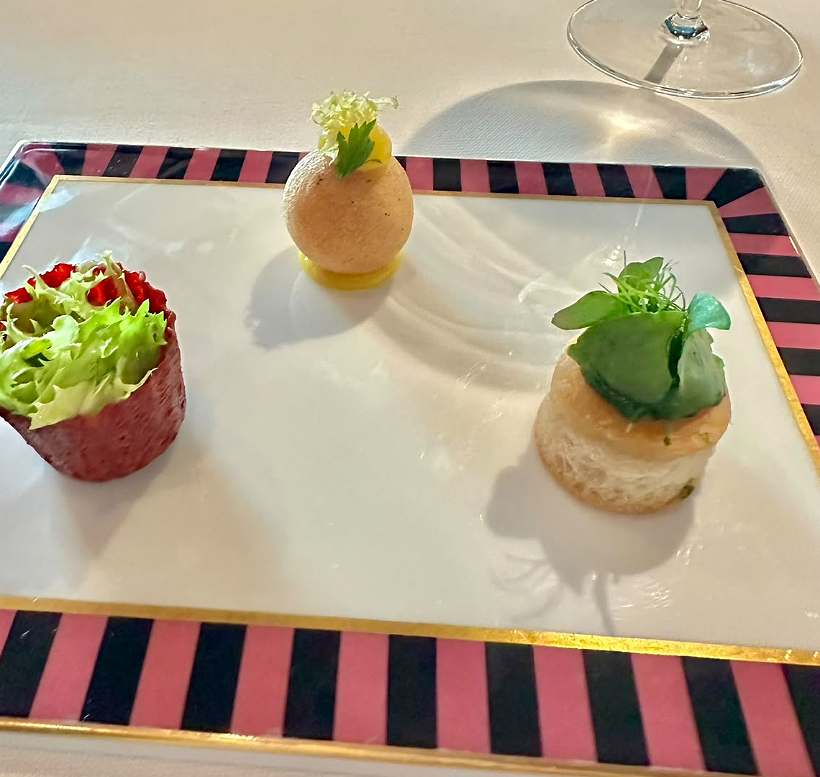
The photographs keep that first approach: small portions, each with its own shape, on strikingly designed tableware. Before the pasta that would impress me so much, the menu already showed its readiness to change language at every stage.
Difesa della Natura, Achrome and Grande Rosso
Difesa della Natura had one of the most beautiful presentations of the journey. Artichoke and herbs appeared on a surface of colorful vegetable purées. The stripes, the tones and the small green elements made the dish resemble a painting. [6]
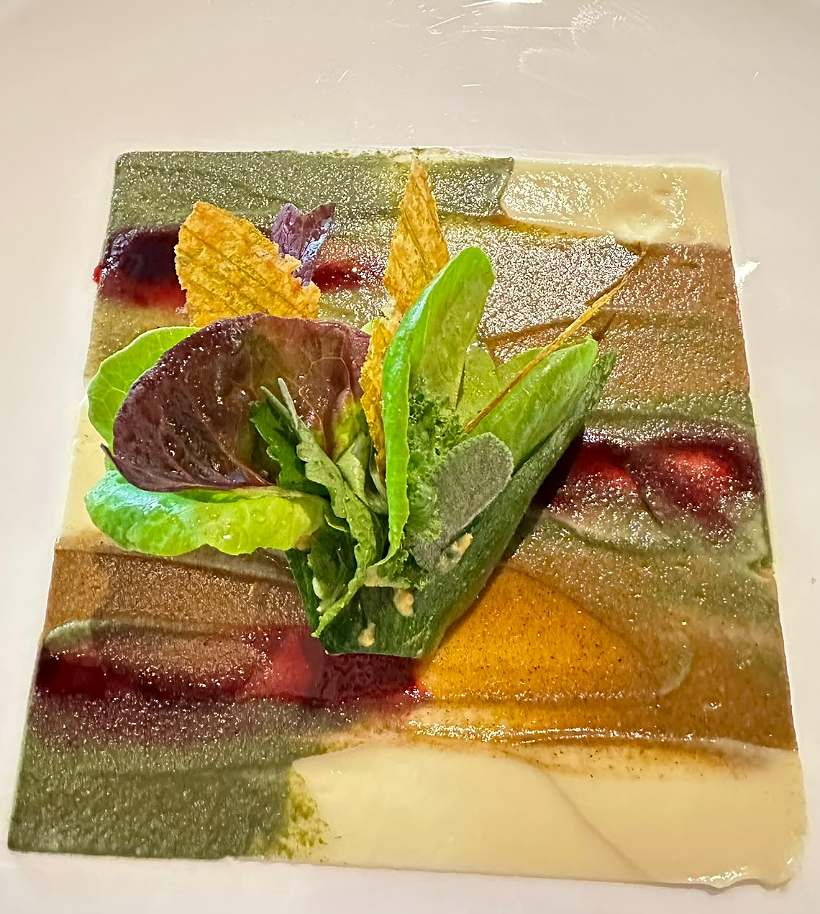
Achrome, listed on our menu, pays homage to Piero Manzoni with red mullet under a veil of fennel and fish bisque. [6]
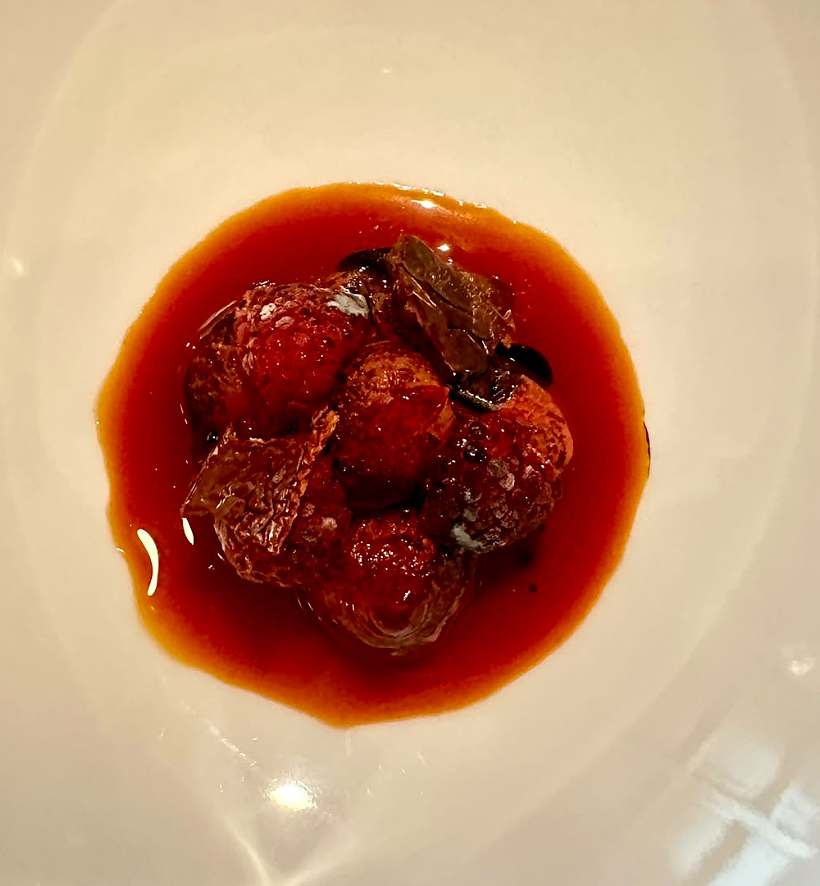
In Grande Rosso, red came to dominate the plate. The composition brought together red prawn, raspberry, tomato and red pepper. In the photograph, the elements appear concentrated in the center of the plate, surrounded by the intensely colored sauce. [6]
Pasta e fagioli, seen another way
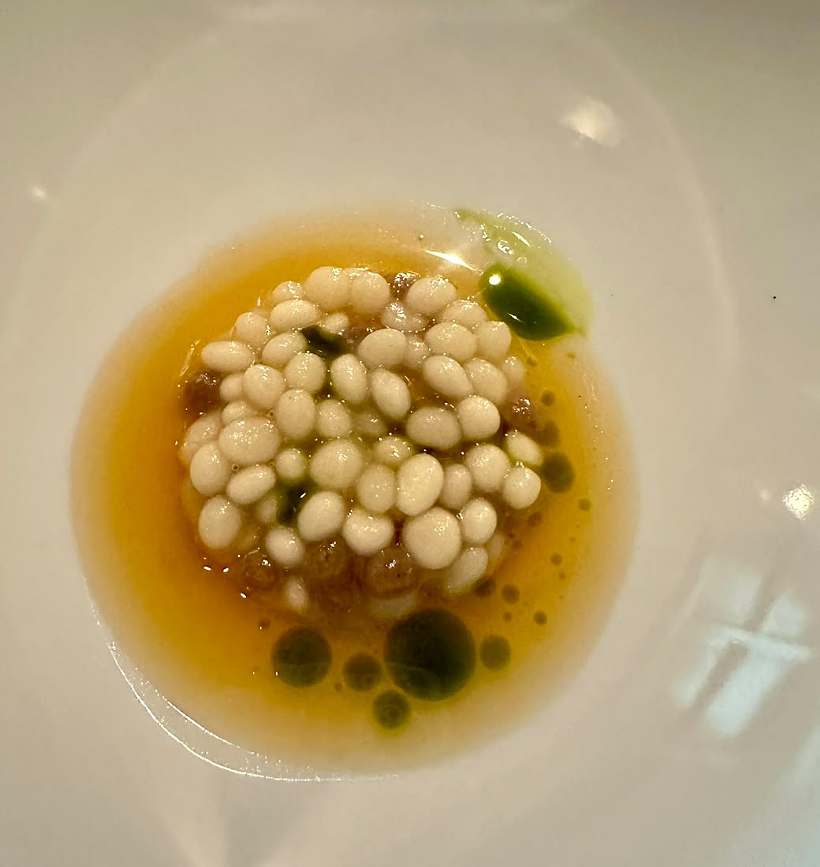
The next title was a question: Dove vuole andare, ancora, questa pasta e fagioli? The Italian recipe of pasta with beans took another form. In this menu’s interpretation, small spheres of pasta appeared with a culatello broth, keeping a link to the cooking of the region. [5]
The sequence made us recognize references and, at the same time, perceive them in a different way. I like how this cooking can awaken curiosity before the first forkful. In the next dish, however, the memory went far beyond the presentation.
Tagliatelle 3.0: the best pasta of my life
The tagliatelle arrived yellow, coiled in the center of a wide plate, with the ragù on top. Visually, it was a concentrated presentation. On eating it came the certainty I still hold today: it was the best pasta I have ever eaten.
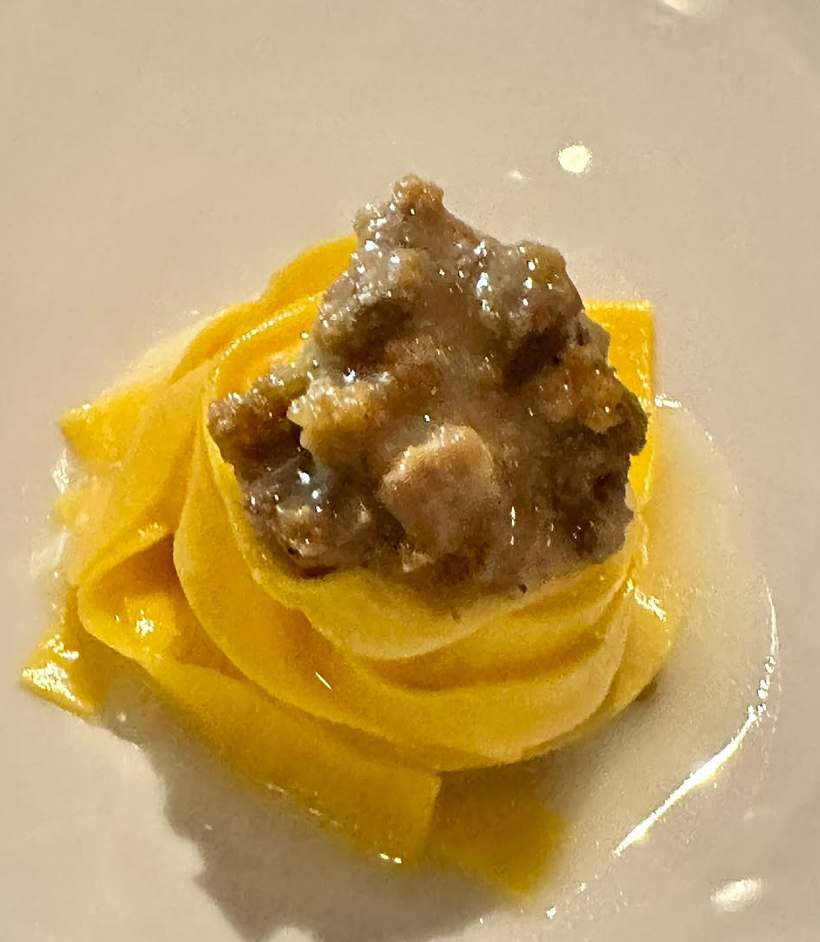
This version works with a pasta made with egg yolks and a ragù in which beef and pork appear in small cubes, cooked at low temperature. The recipe revisits tagliatelle alla bolognese, preserving the bond with Emilian tradition. [6]
It is curious that, in a meal so tied to concepts and references, the most striking moment was so direct. I was facing a plate of pasta and wanted to keep eating. All the elaboration of that dish resolved into a satisfaction that needs no complicated explanation.
The pigeon and the provocation about tourism
In the protein course, the pigeon took center stage. The menu called it Mediterraneo Contemporaneo. The meat came with other small preparations, among them a salad, aubergine, a portion of pizza and a broth: different expressions of the Mediterranean table gathered in the same course. [6]
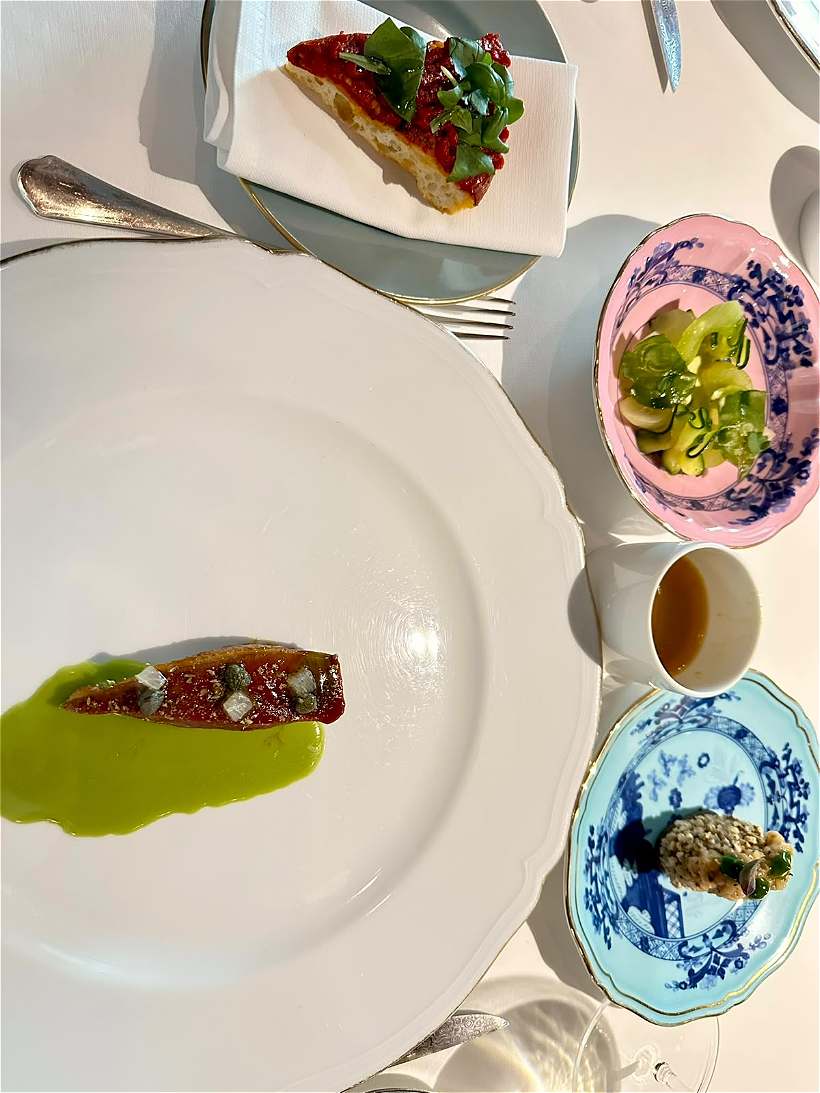
The explanation we received at the table stayed in memory. The team presented us with an association between the pigeon and mass tourism in Italy, an artistic provocation about the many visitors who come to the country. That is how I remember that conversation: the food opened space to think about the very trip we were making.
This meeting between the dish and its narrative is an important part of Francescana’s personality. Bottura’s cooking can work with an Italian memory, a work of art or a question about the present. It is up to those at the table to follow these proposals and find their own relationship with them.
Alba, light and darkness
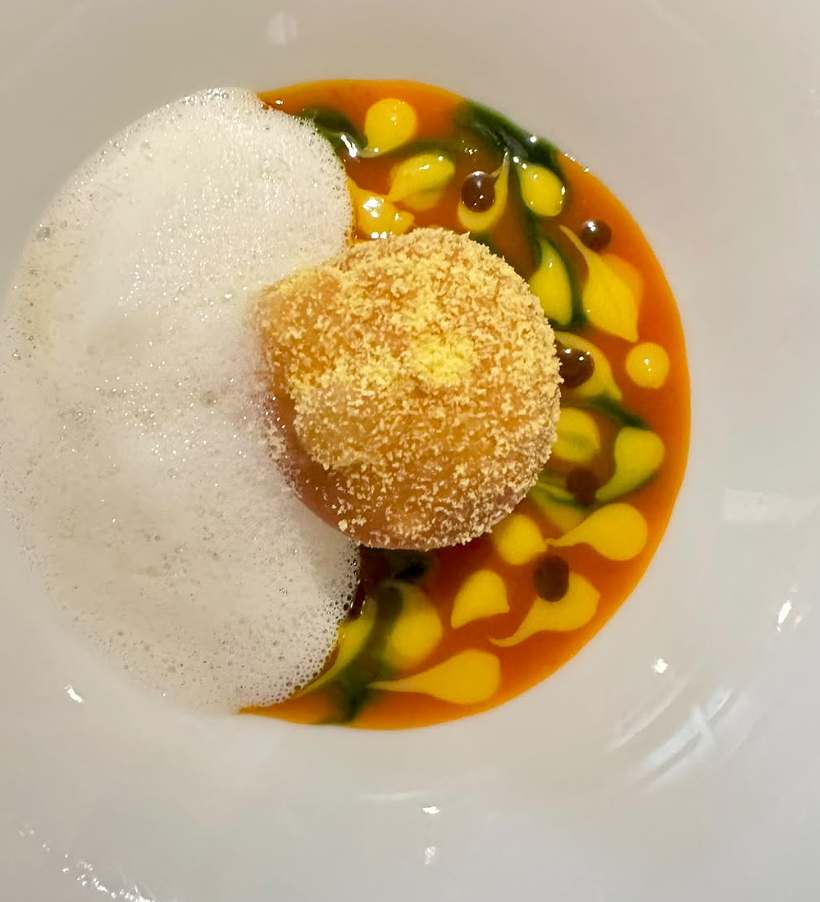
The finale continued this dialogue. In Alba, the composition appeared with pale foam, small green dots and an orange-toned sauce. The dish refers to Sicilian flavors, such as almond, lemon and olive. [5]
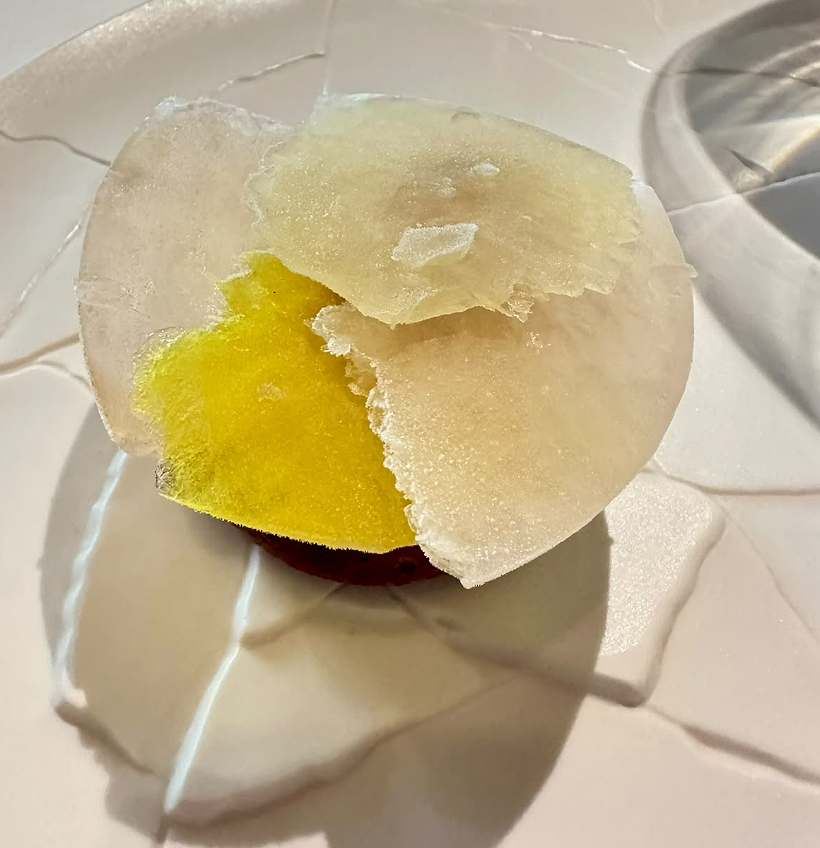
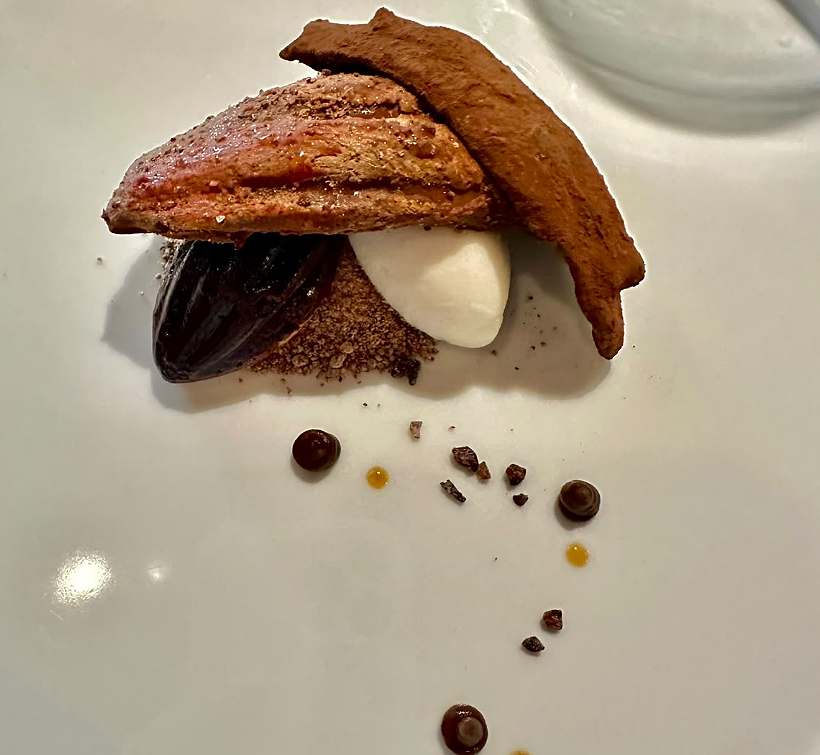
La Luce and L’Oscurità formed a passage between light and dark. The first appears in our photos with pale and yellow slivers on a delicate base. In the second, chocolate elements predominate, in a presentation of dark tones. [5]
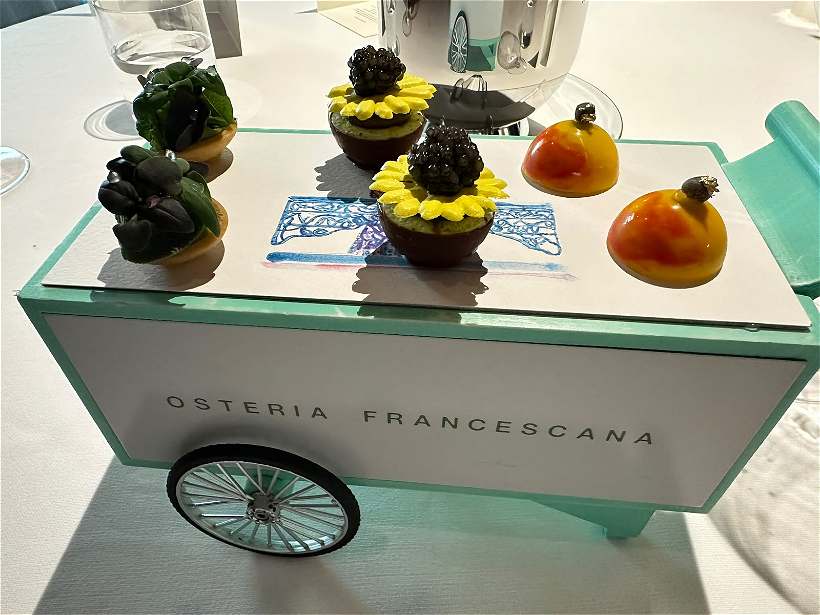
The small sweets of Untitled arrived on a stand reminiscent of one of the Osteria’s own trolleys. Colorful miniatures and different finishes extended the visual care to the very last service.
The risotto that helped Parmigiano Reggiano producers
There is a story about Bottura that deserves to accompany the account of this table. In 2012, the earthquakes that struck Emilia-Romagna toppled and damaged thousands of wheels of Parmigiano Reggiano. The problem affected the food, the work of the producers and an important part of the local economy. [7]
Bottura responded with a recipe and a mobilization: the risotto cacio e pepe. The inspiration came from the combination of cheese and pepper, reinterpreted with rice and Parmigiano Reggiano. By publicizing the preparation and encouraging chefs and home cooks to make it, he helped boost demand for the cheeses and the sale of the affected production. [7] [8]
It is a story that widens the meaning of a chef’s work. The same ability to imagine a recipe can be used to bring people together around a concrete problem and support those who produce the ingredients.
Food for Soul and cooking as a social gesture
This work is also found in Food for Soul, founded by Massimo Bottura and Lara Gilmore. The organization works on recovering food surplus and fighting social isolation. In the Refettorios, meals are part of a proposal of welcome, togetherness and dignity. [9]
In Modena, Bottura and Gilmore also support Tortellante, a project in which autistic people learn and work making fresh pasta, accompanied by a team and by volunteer women who share the knowledge of tortellini. Culinary tradition takes part in a path of training and autonomy. [10] [11]
Learning about these initiatives gives the visit another dimension. Bottura’s relevance is expressed in his signature cooking, but also in using the visibility he has gained to sustain projects that reach other tables and other people.
Modena beyond the Osteria
Bottura’s universe allows you to extend the trip through the region. In Modena, Franceschetta58 offers a more informal setting, with a contemporary reading of local flavors. In Maranello, Cavallino was born from a collaboration with Ferrari and works with Emilian tradition. [12]
For lodging, Casa Maria Luigia, by Bottura and Lara Gilmore, is a guesthouse in the rural landscape of Modena. Art, music and gastronomy are part of the proposal. The experience Francescana at Maria Luigia also takes place there, dedicated to dishes that marked the history of the Osteria. [13]
On the same property is Al Gatto Verde, with the cooking of Jessica Rosval, focused on fire, Emilian flavors and the seasons. These are experiences with identities of their own, which can make up a trip around Modena according to the interests of the visitor. [14]
A journey through modern Italian cuisine
Osteria Francescana was one more opportunity to get to know a restaurant that has reached number one in the world. What we took away from it, however, has a very personal measure: the small room, the attentive and polite service, the explanation about the pigeon and that tagliatelle that entered my memory for good.
For those who wish to experience a modern interpretation of Italian cuisine, Modena deserves time in the itinerary. The meal can be the starting point for exploring the region, its producers and other tables, with each experience chosen for what it adds to the trip.
It is with this care that The Prime Traveler’s Gastrotrip creates personalized gastronomic itineraries: connecting restaurants, hotels and destinations to your tastes and travel dates, subject to the availability of each house.
Some trips are kept in a dish. Discover The Prime Traveler’s Gastrotrip and commission your personalized gastronomic itinerary.